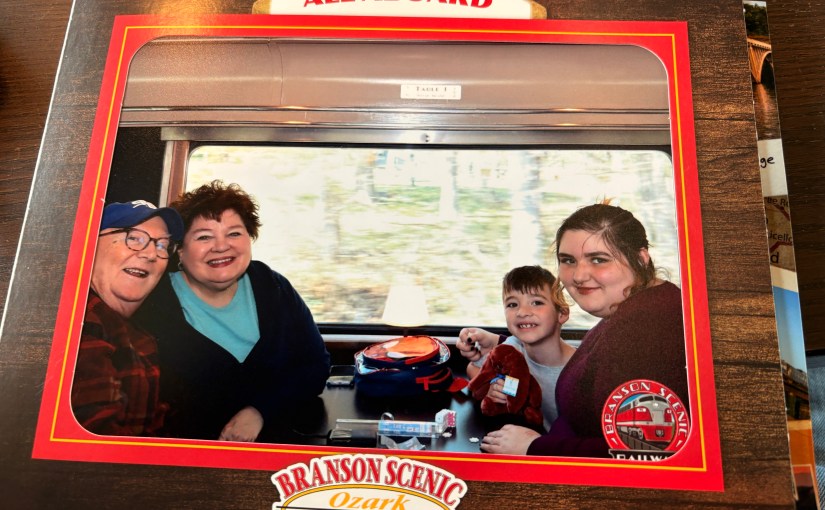
Heaven bound on the Branson Scenic Railway

About the board the Branson Scenic Railway


My family and I rode the rails on the Branson Scenic Railway this week with about 200 of our closest friends. We shared a nice table for 4 in an historic railcar from the 1950s that had been restored.

We were on this journey at the insistence of my 6-year old grandson, who rode it with me last year. He was excited to show it off to his mother and GiGi this time around.

This trip took us from the station in downtown Branson northwest through the community of Reeds Springs and ending on the southern edges of the town of Galena, Mo. We stopped for a couple of minutes on a long trestle that crossed the James River, then headed back to Branson on what would be a relaxing trip of just under two hours.

Our railcar, the Silver Lake, was full except for one empty table across the aisle from us. Seated at the first table beyond that was a man and his wife that I estimate were roughly 65 years of age.

The husband wore a T-shirt that said “Heaven is my home” in large print on the front. I saw him looking over at our table several times.

Finally, as we neared Branson on the return trip, he walked over to our table and struck up a conversation.

Had we been to the Sight and Sound Theater where they re-enact stories from the Bible? They have live animals and realistic scenes, and it’s so good that people have been saved because the Spirit of God moves them.

Then he dropped the hammer.

“Do you know Jesus?” Well, uh, we do, we said. Yes, sir.

“Well, I’m glad because I want to go to heaven and hope you do, too.”

With that, Mr. Heaven Bound went back to his table, and we could relax. I’m not sure why he singled us out, unless our dress identified us as part of the Great Unwashed. I was wearing a Flannel Shirt and OKC Comets cap. My wife had on a blue sweater.

The rest of the ride was pretty uneventful until just before we arrived at the station. A conductor came by and greeted everyone, including Heaven Bound and his wife.

All of a sudden, he loudly addressed the entire railcar of passengers.

“I really enjoyed traveling with all of you,” he said. “I hope you all know Jesus and hope to get to Heaven. I plan to go to Heaven and not the other place.”

Then an awkward quiet washed over the entire railcar. Fortunately, we pulled up to the station right then and everyone piled out as quickly as possible.

I’ve been in uncomfortable situations like that several times in my life, when someone so passionate about their faith that they want to grab you by the collar and force feed some Jesus down your throat.

I appreciate their passion, but not sure how this form of proselytizing can win many souls. I think it makes people run the other direction, even those of us who attempt to follow Jesus in some fashion.

To me, this type of ‘Gospel sharing’ is a shallow attempt to convert someone when there’s no history between either party or context to the theology he’s trying to reach them with.

Besides, everyone’s faith journey is different. I respect those whose journey has landed them in the arms of Jesus or another religion or even no religion at all.

When we all get to heaven we may be surprised to see who we meet there.
Aboard the Branson Scenic Railway

Dunning-Kruger Effect: I knew it all … until I realized I didn’t

When I graduated high school in 1971 — in the bottom half of my class academically — I plunged into my future thinking I pretty much knew everything I needed to know and could handle anything coming my way.

However, I didn’t know what I didn’t know.

It didn’t take long to realize that I had few skills or knowledge to navigate both life and a career. My confidence in myself took a steep dive.

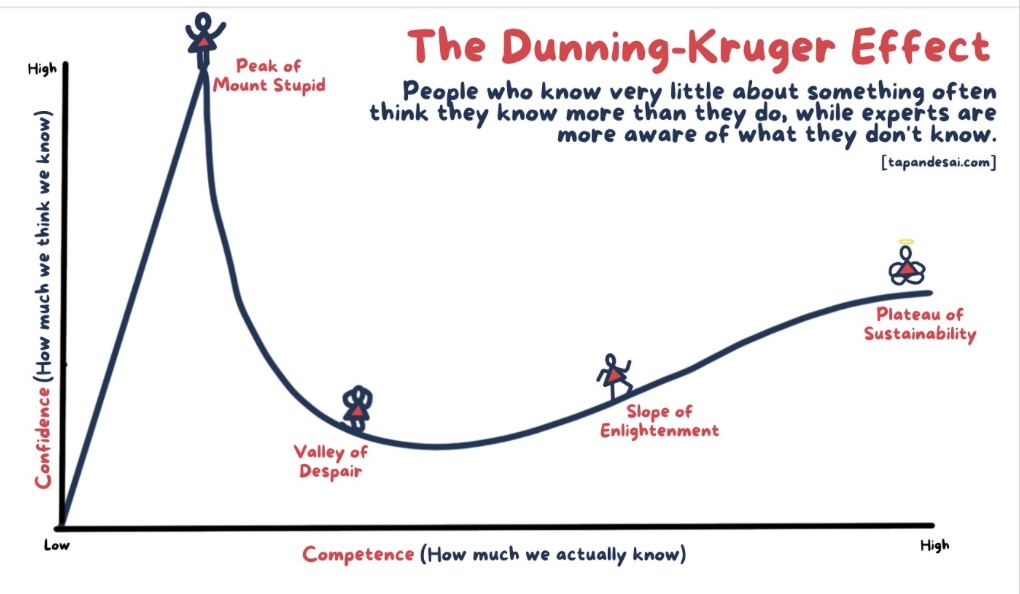
I’m writing about this because I saw a chart of what is known as the Dunning-Kruger Effect this week that perfectly described what I experienced. I’ve since found multiple versions of the chart online and posted one at the top of this column.

Developed by psychologists David Dunning and Justin Kruger in 1999, the Dunning-Kruger Effect describes what is called “unconscious incompetence,” when you truly don’t know what you don’t know and wrongly assume you know it all.

Many of the charts I’ve seen label the point at which a person has the most incorrect confidence in their knowledge or ability as “Mount Stupid.”

They certainly got it right in my case.

When I realized I didn’t know it all or possess any skills to actually have a successful career, my confidence hit bottom. Dunning-Kruger calls that the “Valley of Despair.”

Gradually, as you gain more knowledge and skill along the way, the Dunning-Kruger line begins to rise with the “Hope of Enlightenment” followed by the “Plateau of Sustainability.” No one knows it all, so even at the Plateau, there is still plenty to learn.

As I progressed in life, first in a retail job, then on to college and finally into a journalism career, I took tentative steps along the way, knowing I had a lot to learn.

Even at my current advanced post-retirement age, I realize there is so much I don’t know and struggle to sustain confidence.

So, where did I see the Dunning-Kruger Effect chart last week? It was projected onto the screen at the Sunday service at The Springs Church of Christ, a congregation of which I am a member.

Ryan Jones, a member of our church and a deep thinker, delivered the Sunday sermon as apart of our annual summer series when guests bring the message as a supplement to the work of our staff pastors.

I’m not sure he came right out and said it, but I’m pretty sure Ryan posted the Dunning-Kruger Effect because a lot of people in Christianity wrongly assume they have all knowledge when it comes to religion.

In other words, they don’t know what they don’t know.

Ryan’s sermon and the chart made me think not only of the younger me, but the hundreds of over-confident fellow Christians I’ve known over the years who assume that their corner of religion has it all down correctly and anyone who doesn’t do it their way is lost.

I’ve come to the conclusion that everyone’s faith journey is different. And that leads me to believe that I can’t condemn anyone whose journey arrives at a different spiritual perspective than me, or away from Christianity or to no religion at all.

Of course, my confidence level in all this is pretty low, because I’m still learning that I don’t know what I don’t know.

It’s a life-long lesson.