Fading glory: Bricktown Ballpark needs upper deck rehab

Advertising banners cover the entire upper deck seating area down the first base line of the Bricktown Ballpark.

I was enjoying a summer evening at the Chickasaw Bricktown Ballpark with a friend last year, savoring the crowd, the game and the park’s immaculate green pasture.

Then my eyes landed on the upper deck along the first baseline that extends out into right field. There were no seats or bleachers visible. Only advertising banners draped across each section.

The faded tarps have been there for years, at least since the ownership group that renamed the team the OKC Dodgers took over, maybe longer. I mentioned to my friend Steve that I found the tarps covering the seating area unsightly.

“It’s not a good look,” replied Steve, who, like me, is a partial season ticket holder.

Don’t get me wrong. Oklahoma City has a beautiful ballpark that has retained its attractiveness since it opened in April 1998. However, the tarps do nothing but detract from the ballpark’s charm.

The sight stirs memories of when I attended an Oakland Athletics game in 2004 at what was then called McAfee Coliseum. I knew it as Oakland–Alameda County Coliseum growing up.

Anyway, there is no charm to that stadium, beginning with the chipped concrete exterior and on to the narrow, dark concourse.

But the A’s venue has come to be known for the massive tarps that circle the entire upper deck. It’s as if the team gave up on its fan base years ago. Which, of course, it did, and is relocating soon to Las Vegas.

Back to the Bricktown Ballpark. I’ve enjoyed many summer nights there over the years and seen some spectacular games and individual plays. The team continues to attract fans in large numbers, especially on weekends.

I guess it comes down to what the team’s management thinks detracts from the ballpark experience more: empty upper deck seating areas on most nights or fading advertising banners covering those seats. I take it as a sign that no one anticipates crowds large enough to need them ever again.

I contend that an entire second deck of seating covered in fading tarps makes the Ballpark looks less inviting and a little tired. It’s not sending a signal of anything fresh and exciting.

So, I’m proposing some changes that would help the look and appeal of the ballpark. I’m not sure if it’s the responsibility of the team or the city for upkeep, maintenance or rehab of the park.

But here goes.

First, I would reinstall seats in the first two upper deck sections closest to home plate. Then I would install bleacher seating in the remaining upper deck sections down the first base line.

The team could market the two sections with actual seats as special group sections or maybe for special events. My friend Russ even suggests carving out a “party deck” into the area.

As for the bleacher seating, the team could market that as general admission seating and invite the public in for $10 a ticket or something like that.

And the tarps all would go into the nearest dumpster.

The point of all this is to restore the beautiful Bricktown Ballpark close to its original look and make it even more inviting.

So, I’m asking the OKC Baseball Club and the City of Oklahoma City to consider the possibilities and make our ballpark look as beautiful as it was on April 18, 1998.

Let’s eliminate comparisons to a tired old stadium like that in Oakland. Our ballpark is better than that.

Bricktown Ballpark remains a beautiful venue.

For Ed, Cardinals baseball a lifelong ‘addiction’

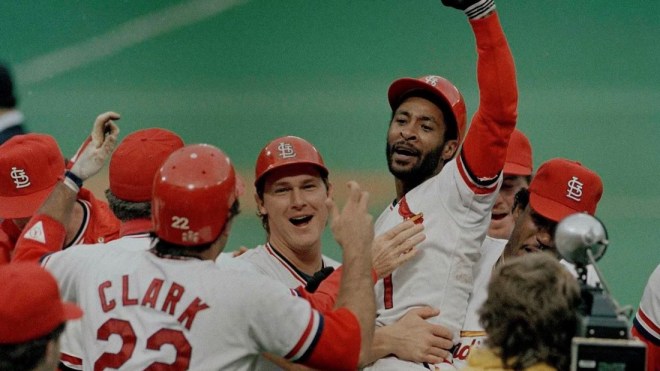
Ozzie Go Crazy
Ozzie Smith’s St. Louis Cardinals teammates celebrate his game-winning home run vs. the Dodgers in the 1985 playoffs

Editor’s note: My friend Ed Godfrey grew up in Eastern Oklahoma as a passionate St. Louis Cardinals fan, a devotion that began by listening to their games on his family’s big console radio. More than 50 years later, Ed remains a baseball fan and still follows the Cardinals with the same passion as he did as a 10-year-old Stigler Little Leaguer. I asked him to write about what sparked his fandom for the team from St. Louis, and he obliged with this essay.

By Ed Godfrey
When I was a kid, baseball was king. That gives you a clue to how old I am. Yes, I am old enough to draw Social Security.

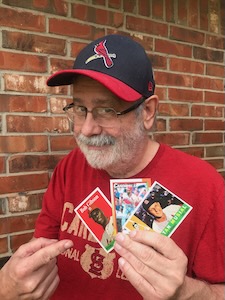
Ed 2
Ed Godfrey

I played Little League baseball, proudly donning the uniforms of King’s Tire Service, Guaranty Abstract and Davis Packing Company, some of the generous sponsors in Stigler who allowed the town’s pre-teen youth to live out their summer dreams on the ball diamond.

Like the Cardinals great utility man in the ’80s, Jose Oquendo, I would play everywhere on the field at some point. Dad nixed my playing days at catcher after just one game because he was afraid I would get hurt.

Center field was my best position, but I also took the bump a lot. I didn’t have Nuke LaLoosh stuff, but I could do what often none of my other teammates could do. Throw the ball over the plate.

Man, I loved baseball. Whenever I had a dime, I would ride my bicycle the six blocks from home to the Five & and Dime store in downtown Stigler and buy a pack of baseball cards.

I was a pretty avid card collector in the early ’70s. And yeah, I stupidly put some of them on the spokes of my bike and glued others in a scrapbook, but most of my treasures are still intact. Thank you, mom, for not throwing away my baseball cards.

As you get older, I think the more you want to go back and be a kid again. That’s why I still buy baseball cards today. Nostalgia.

Back when I was a kid, I didn’t miss the major league game of the week on Saturday afternoons. Yeah, we got one baseball game on television each week. I also loved This Week in Baseball narrated by Mel Allen.

And I was a frequent listener of Major League Baseball games on the radio. This is how I became a St. Louis Cardinals fan.

First of all, the Cardinals were really good in the late ’60s. When I was 7, they won the ’67 World Series over the Red Sox. Then when I was 8, they lost the ’68 World Series to the Tigers.

(Don’t ask me about the ’85 World Series against the Royals, I am still ticked off about Game 6. Now, Game 6 of the 2011 World Series Game 6, that one was magical)

For many years, the Cardinals were the only major league team west of the Mississippi River and they developed a loyal following thanks to mighty KMOX-AM radio, which had a long reach throughout the South and Midwest.

KMOX helped turn countless families into Cardinals fans since 1926, including a kid in Stigler, Oklahoma.

When the Cardinals played on the West Coast and games started past my bedtime, I would sneak a transistor radio under my pillow so I could still listen to the broadcast without my parents knowing.

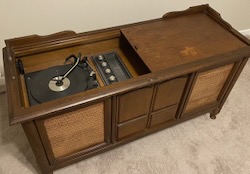
ConsoleOtherwise, I would listen to games on our bulky old stereo-record combo that we had in our living room. In 1971, and I can still hear Jack Buck’s call of Bob Gibson striking out Willie Stargell to end the game for Gibby’s only no-hitter of his career.
“If you were here, it would have made you cry,” Buck proclaimed.

I wasn’t there but I felt like I was, thanks to one of the great baseball announcers in history.

When the Cardinals made the playoffs in the ’80s, every game, of course, was televised. But I turned the volume down on the TV and tuned in the radio for the play by play to listen to Buck.
I got to hear his great “Go Crazy” call in the ’85 National League Championship Series against the Dodgers when Ozzie Smith unexpectedly hit the game-winning homer in Game 5.


I did “Go Crazy” in my apartment in Edmond, leaping from the sofa and landing on my knees in front of my TV in celebration.

A few years later I started dating my future wife. She tolerated my obsession with the Cardinals and actually enjoyed listening to Buck’s voice, even though she knew little about baseball.

Instead of going out on the town one Friday night, she drove from Norman to my apartment in Edmond and agreed to watch the Cardinals-Braves game with me on what was then Ted Turner’s superstation, TBS, which carried all the Braves games.

I promised we would go out for dinner after the game. It lasted 22 innings. My man Oquendo even came in and pitched when the Cardinals’ bullpen was depleted. (Told you he was a great utility player). He pitched several scoreless innings, but the Cards couldn’t get him a run and they lost.

Linda watched all 22 innings and never complained. Maybe she slept through an inning or two, I can’t remember for sure, but the point is she stayed until the end and then drove back home in the early morning hours. As Buck would say, “That’s a winner.”

I don’t listen to Cardinal games on the radio anymore because Buck and his broadcast partner, Mike Shannon, are no longer with us. Nothing against the new announcers, but it’s not the same for me.

This summer, I even stopped watching the Cardinals on TV because they stink this season. It’s been a long time since they have been this bad.

Well, the truth is I haven’t quit on them completely. I still sneak a peek once a while to see if the bullpen is going to blow another game and then I start cussing when they do.

It’s a lifelong addiction.

An OKC Field of Dreams and ghosts of baseball past

fieldofdreams
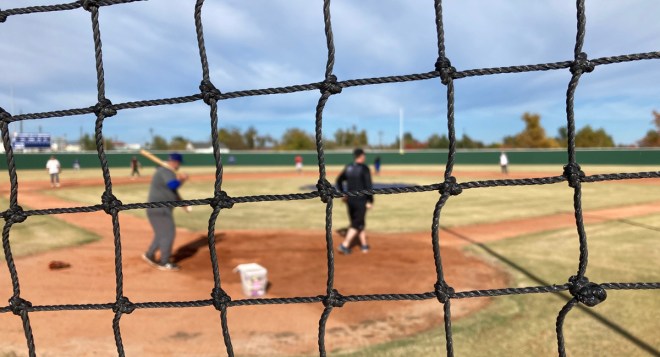
A group of OKC adults turned the Northeast High School baseball field into their own ‘Field of Dreams’ for an afternoon

Moneyball is one of my favorite movies. It shows the impact that using computer statistics to drive player development had on Major League baseball and the Oakland Athletics in the early 2000s.

The movie features a host of memorable scenes, including one where Oakland outfielder David Justice asks new first baseman Scott Hatteberg what he feared most at the position.

Hatteberg had been a catcher all of his professional career, and to that point had never played even an inning at first base.

“A baseball hit in my general direction,” was Hatteberg’s honest reply to Justice’s question.

That’s exactly how I felt Sunday afternoon as I stood in right field at the Northeast High School baseball field.

I was there at the invitation of my friend, Russ Florence, who invited a group of fellow adults to “have a catch” with him.  A lifelong baseball fan, Russ began his informal monthly “catch” several months ago.

It was sort of a Field of Dreams-come-to-real-life opportunity for those of us who once played the game or have followed it all of our lives.

The baseball dreamers who came out Sunday included several guys my age or older, a few younger and a couple of women who showed more agility than most of their male counterparts.

I dug my old baseball glove out of the closet and joined about a dozen others at the Northeast field.

Unfortunately, the experience revealed exactly how the passage of time has robbed me of athletic ability, real or imagined.

Once upon a time, I thought of myself as a pretty good baseball player. Now that was in Little League in College Station, Texas, followed by Pony League as a 13- and 14-year-old.

Here’s how it went five decades later on a warm November afternoon beneath a bright blue sky.

First, we warmed up by playing catch with a partner about 40 feet away. I put most of my throws into the ground in front of him or several feet to his left.

My shoulder ached after about 15 minutes. My glove hand screamed with pain from catching baseballs in the heart of the mitt.

Then came the real embarrassment. I stood in right field as Russ hit flies and grounders to players stationed at infield and outfield positions.

He hit one in my general direction.

My feet felt like they were in quicksand as I “ran” toward it. I could not bend over far enough to even make a stabbing attempt at a catch.

I hung my head in shame. No one seemed to notice.

Russ hit about three other balls in my direction. I managed to catch one on the bounce barehanded, but caught none before they hit the ground. I decided if a ball wasn’t hit within three feet of where I was standing, I had no chance.

But the day wasn’t a total loss. I had the opportunity to visit with some old — and new — friends. The weather was pleasant watching from the dugout, where I spent much of my time.

“It really scratches an itch for a lot of people,” Russ told me afterward. “None of us is as good as as we once were — or as good as we THINK we once were. I’m glad you were there.”

Thank you, Russ, for inviting this ‘ghost’ of a former player to experience your OKC version of the Field of Dreams.

Even if it brought home a sobering reality of aging.

Catching static: Memories of listening to baseball on AM radio

I was driving in eastern Oklahoma way back in the early 1990s when my wife had enough. “Turn off that static!” she demanded.

At the time, I was listening intently to a Texas Rangers baseball game on the AM radio broadcast of Fort Worth, Texas, station WBAP.

To be honest, I had not even noticed the static.

That was life in the olden days, when baseball fans like me would tune into distant AM radio stations like WBAP and KMOX in St. Louis to follow our favorite teams.

As a teenager, I lived on KMOX and the soothing voice of Jack Buck calling the Cardinals games. Later on, it was Mark Holtz and Eric Nadel with the Rangers.

Bonus: Read this terrific New York Times article on the power of KMOX as a reporter tries to outdrive the station’s coverage during a Cardinals’ game broadcast.

After dark, the distant signal from my favorite AM stations boomed across the AM receiver located either in my bedroom or my car.

But static was a price you paid to listen to distant AM radio broadcasts. In the spring and summer, static was almost always present because of thunderstorms somewhere between you and the radio tower.

So, you learned to pick out the play-by-play from the static. I sort of trained myself to tune out the static, which is why I faced the wrath of my wife. 

It wasn’t only the distant sports stations that I tuned into as a teenager. WLS in Chicago was my go-to station to listen to the latest Top 40 hits.

Recently, someone posted a map on LinkedIn that showed the vast coverage of Oklahoma City’s KOMA. Unfortunately, I lived in the wrong part of the country as a kid to become a KOMA fan.

Anyway, the days of straining to hear baseball play-by-play or Top 40 music through a static-riddled broadcast are mostly in the past. I subscribe to MLB.com’s audio broadcasts now, which bring in the Rangers, Cardinals or any Major League team static free and crystal clear.

With bluetooth, I stream the broadcast to the car’s sound system and never miss a pitch.

And I no longer endure the wrath of someone who doesn’t understand the pleasure of ignoring the static to enjoy the game.

Baseball deaths and the passage of time

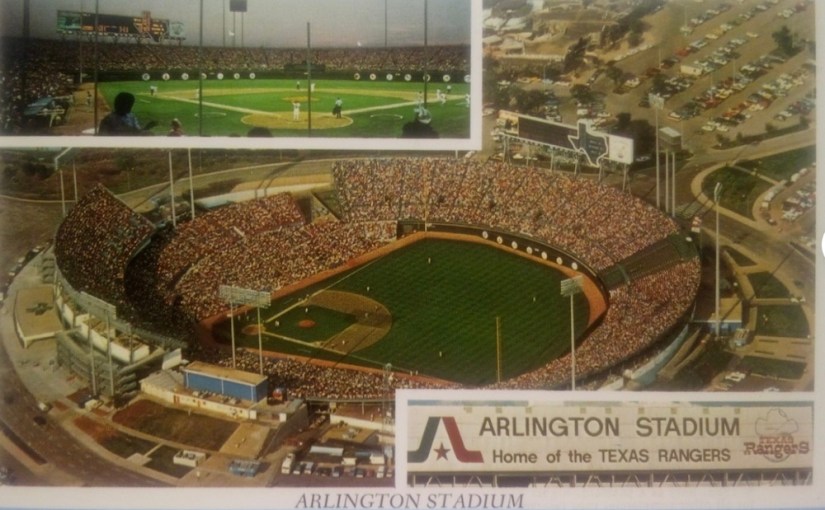
Colt Stadium in Houston was the locale for my first Major League baseball experience

The death of baseball Hall of Famer Joe Morgan this week took me back to the early 1960s and a rickety old stadium in Houston where I saw my first Major League Baseball game. I was there with my Little League team from Bryan/College Station.

We all wore our uniforms, as did about 5,000 other Little Leaguers that day. The outfield stands were a splash of rainbow colors from so many uniformed youngsters sitting together.

While I don’t remember anything about that game from 1963, I do remember that Joe Morgan was a member of the Houston Colt 45s, who were playing the St. Louis Cardinals. Jimmy Wynn, known as the Toy Cannon, also was a member of that team.

Bonus memory: We could see the Astrodome under construction right next door to Colt Stadium, so the baseball future held a lot of promise for a 10-year-old.

Of course, Morgan eventually was traded from Houston and built his Hall of Fame career as a key player with the 1970s Big Red Machine in Cincinnati. The Houston Chronicle published a story this week about how he was the one that got away. Read it here.

That 1963 Houston Colt 45s experience pretty much ensured I would be a lifelong baseball fan.

Like most kids of the time, I collected baseball cards and memorized the starting lineups of the teams. I even made up my own stats-based game that mimicked the APBA baseball board game but used a spinner instead of dice.

Joe Morgan as a Cincinnati Red

Fast forward more than half a century to the awful year of 2020. Morgan and Wynn both died this year. They are among a host of former Major League players who passed away in 2020, a list that includes all-time greats like Bob Gibson, Lou Brock, Tom Seaver, Al Kaline and Whitey Ford.

Baseball Reference publishes a running list of every former player who died this year. You can see the list here.

The deaths of Seaver, Ford, Brock, Gibson and Morgan came in rapid succession. It hurt. As a child of the ‘60s, it’s painful to watch my heroes pass into history. 

Each death hammers home the passage of time, but I’m hanging on to the distant memories. It’s all we have left in the end.