Chatbot comes alive for OKC audience in demo

Dodd AI3
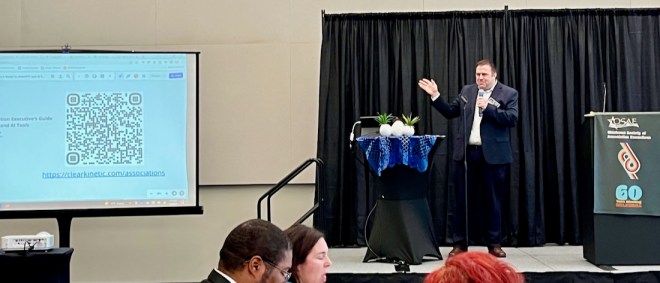
Bucky Dodd, Ph.D., founder & CEO of technology firm ClearKinetic, demonstrates an AI Chatbot at a recent OKC meeting.

“If you came here today for answers, I’m sorry, you will probably leave with more questions.”

That’s how Bucky Dodd, Ph.D., a long-time educator and CEO of an educational technology startup called ClearKinetic, launched his presentation on Artificial Intelligence last week to a group of association executives at the OKC Convention Center.

Dodd obviously follows author Stephen Covey and his 7 habits of a highly effective person.

Begin with the end in mind.

But Dodd’s presentation was more of a show-and-tell to his audience from the Oklahoma Society of Association Executives. He prompted a Chatbot to actually generate some amazing content for us.

I happened to be there at the invitation of a friend who knew I had an interest in AI and had previously written about it.

Questions from the audience began even before the presentation. What about AI’s impact on jobs? What about plagiarism?

Those are certainly legitimate concerns, but Dodd explained that AI, more specifically the Open AI ChatGPT that he demonstrated, are tools built on large language models. It is taught to respond and create content from information humans have created in the real world.

Then he got down to the real purpose of the presentation.

Demonstration.

And it was impressive.

With an audience of association executives, Dodd commanded Chat GPT to write copy geared especially to association professionals. First, he told it to write web content promoting an association convention.

Chatbot wrote the content at an amazing speed, maybe 90 words a minute like that showoff in my high school typing class. The copy was appropriate and engaging.

Then he had Chatbot write an email invitation to prospective convention goers, as well as an email to potential convention sponsors. Next, Chatbot wrote three social media posts for a LinkedIn audience.

But the real eye opener for me was when Dodd told Chatbot to write code for a convention landing page. He wrote a prompt to Chatbot that said “create code for a one-page landing page to promote the conference using HTML, in line CSS, which is cascading style sheet, and include a call to action button in the top right of the website.”

Boom! The computer started writing code like it had been coding for years.

When it was done, Dodd clicked on a button and the code instantly turned into a complete webpage with placeholders for the association’s logo.

Someone asked how did the Chatbot know he was asking for an association webpage.

“Because it’s in a chat window, it’s using the context of the things that came above it to generate it’s next response,” Dodd said.

Then he commanded Chatbot to write an exciting announcement about the conference in the style of Shakespeare.

“Hear ye, hear ye,” Chatbot started out as the audience laughed.

Dodd also showcased another AI called Adobe Firefly that generates images and graphics. An audience member suggested a picture of a penguin holding an umbrella in the snow, and it took maybe 15 seconds for Firefly to draw four separate images of penguins holding red umbrellas. In the snow.

As the presentation concluded, there were more questions, of course. Can Chatbot create logos? Add photos to a webpage? Copyrights? Who owns the content? Chatbot accuracy?

“Because they are machine driven, (Chatbot) can sometimes what they call ‘hallucinate,’ ” he said. “It will generate with a high-degree of confidence very inaccurate information.”

We were impressed, but we still had questions about AI’s future — and our own.

“AI should be used in ways to enhance human creativity and not get in its way,” Dodd said. “We have to recognize that it’s here, but use it in a very intentional and appropriate way.”

Good luck with that.

BONUS — I wrote another blog post back in January that featured Tulsa software developer John Hassell and his experience of implementing AI into his daily workflow.  Read it here.
Dodd AI2
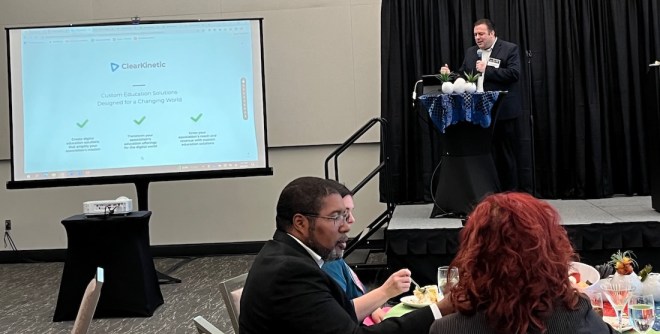
Bucky Dodd, Ph.D., writes commands to Chat GPT that are instantly carried out on the screen during his demo.

For software engineer John Hassell, the future is now for AI Chatbots

JohnHassell2023
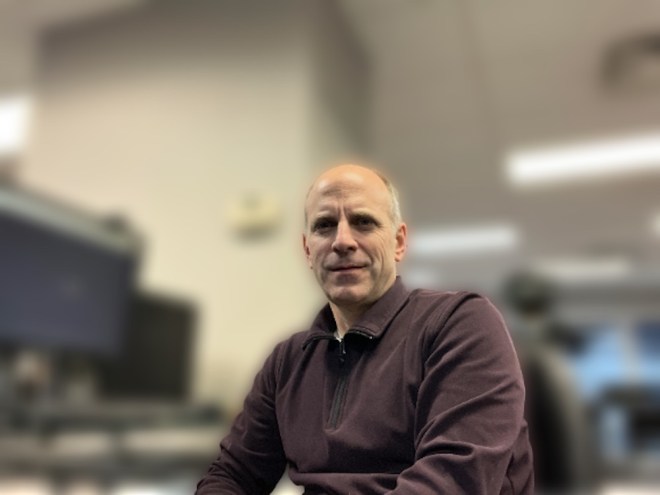
Oklahoma-based software engineer John Hassell has embraced artificial intelligence chatbots as part of his daily workflow.

In the past couple of months, I’ve heard more about artificial intelligence (AI) chatbots than any other topic, except, perhaps, the media hysteria caused by Chinese spy balloons.

According to IBM, a chatbot is a computer program that uses artificial intelligence and natural language processing (NLP) to understand questions and automate responses to them, simulating human conversation.

In fact, it was just a month ago that I signed up on the free Open AI ChatGPT website and asked Chatbot to write me a couple of essays on the Oklahoma City Thunder’s tanking philosophy.

The essays turned out well written and with solid arguments.

Meanwhile, we’ve seen a lot of hand-wringing from ethicists over the potential of AI bots to write term papers for high school and college students or mimic the voice of well known people to have them say outrageous things.

So, the jury’s still out on what our future will look like with AI Chatbots churning out reports, papers and art. But there are people who already embrace the potential of chatbots as tools to enhance their workflow.

One of those is Oklahoman John Hassell, who works as an embedded software engineer for Tactical Electronics in Broken Arrow. I’ve known John since 2005, when he was a Ph.D. candidate at the University of Oklahoma and entered the Donald W. Reynold’s Governor’s Cup collegiate business plan competition with a concept known as ZigBeef.

As pitched by John and his team in the Governor’s Cup, Zigbeef applied RFID technology to ear tags for cattle as a way to easily identify them and ensure a safe beef supply for consumers.

ZigBeef won second place in the Graduate Division of the Governor’s Cup.

After completing his Ph.D. and pursuing ZigBeef for a number of years, John has gone on to work in embedded software development, as well as applying his skills to mobile app development.

So, I was pleased to hear from him recently when he described how ChatGPT has quickly become a major factor in his workflow.

John said he heard about AI and initially was skeptical of any potential benefits.

But an OpenAI art program known as Dall-E changed his perspective. He asked it to draw a photo from his memory of his family’s old two-story farm house near Okemah.

“On a lark, the first time I used it, I typed in a paragraph describing a mental picture of the sandy road, surrounded by a pecan tree orchard, leading up to the white farm two-story house,” he said. “OpenAI’s system produced something shockingly similar to what I was imagining. The picture it created in seconds was suitable for hanging in my office as a picture.”

Now you know why the art world has been in an uproar over AI potential.

Next, Hassell asked ChatGPT to produce some programming code that involved an obscure Linux script.

“In a second, ChatGPT comprehended exactly what I needed to do, and then provided the working code to do it,” he said. “I had been working on that issue for weeks.”

So, now Chatbot is part of John Hassell’s routine workflow. He produced a legislative mobile app for the Oklahoma Electric Cooperatives Association and is working to implement a “quiz” feature as part of it. The quiz required writing a short summary of each legislator.

He assigned the task to Chatbot.

“Once again, ChatGPT provided an easily readable, accurate summary, correctly punctuated, with an interesting fact, for each legislator and their district,” John said. “It was not completely accurate and had to be checked. Nevertheless, it saved an incredible amount of tedium and time in writing this program.”

I wanted to know more about the perspective John has gained about AI and the Chabot, so I asked him a few more questions. Here they are in Q&A format:

Q: How has AI helped streamline or enhance what you do?
A: I’ve actually started to migrate away from my standard resource of programming help, sites like StackOverflow and Google search. Now, I am able to ask specific questions that tend to get me answers quicker.

Q: Isn’t using an AI Chatbot considered cheating?
A: It is somehow cheating the same way that leveraging a calculator was somehow cheating in the 1970s, or that using a tractor instead of a mule team was cheating at the start of the last century. New technology is neither ethical or unethical, it just is. We will find if we aren’t using this technology in future years we are just left behind.”

Q: How much do you worry about inaccurate feedback you receive from Chatbot?
A: In my few short weeks of usage, it has indeed been inaccurate many times. However, the inaccurate solutions provided, or the prose presented, still brought me much farther and quick ahead than without it.

Q: There seems to be some fear about how AI will impact our future in a negative way; what is your perspective on that potential?
A: I can tell you that after using ChatGPT the past few weeks, the user interfaces on my smart phone, on my truck radio, even on most websites, seem antiquated.  Having to search for, and manipulate computer controls, in such a precise and particular manner feels so “old” already. Not to be too dramatic, but this will change will be huge… and it’s happening with record speed.

Q: What else would you like us to know about the topic of AI Chatbots or your work?
A: Interestingly, I’ve gotten better at using ChatGPT in my programming work by thinking less like a computer programmer in many ways. Now, instead of overly-specifying what I need, and the way I need it, I revert to more-human prose, asking what I ultimately need… not trying to tell ChatGPT on how to find the answer for me. I’m having to de-program my decades of learning and specifying the minutiae of how to get things done with a computer. Now, ChatGPT has learned to do a lot of that. I look forward to seeing these improvements in all the tedious things we all have to deal with in interacting with all the machines that are here to help us.

Takeaway: I only heard about ChatGPT a few months ago, and thought that its impact wouldn’t show up for years while it was being perfected.

But as John Hassell has demonstrated, Chatbot’s future is now. We should embrace it.