It’s funny how your memory can distort the facts over the years. When I first met Scott Kirk on the campus of Abilene Christian University in the fall of 1976, I was impressed because he had actually worked for a minor league baseball team in his hometown of Harlingen, Texas.
At least, that’s what I remembered from a distance of almost 50 years.
Scott recently corrected the historical record for me.
In reality, he actually worked as a sportswriter for the Valley Morning Star, covering the Rio Grande Valley WhiteWings baseball team that was based in Harlingen. He even took a year off from college to focus on the job as WhiteWings beat writer.
But I’m not letting the facts get in the way of my warm memory.
I remember Scott Kirk as a fellow student who was committed to sports journalism and loved the sport of baseball above all sports. He was and is one of my favorite writers both in college at the Optimist student newspaper and through a long career with the Abilene Reporter News after graduation. He closed out his career as a high school journalism teacher in Abilene.
By comparison, I was far behind Scott in my writing and reporting abilities when I landed on campus in 1976. But I loved baseball, and that sort of bonded us as members of the Optimist staff. We watched baseball on TV, talked baseball and drove to Arlington to watch the Texas Rangers play.
Scott and I have stayed in touch through the years, each of us playing a role in the other’s wedding, meeting in Dallas or Houston to watch baseball, and once playing a round of golf in 100+degree weather during a scorching Abilene summer.
Although he’s retired from roles as reporter and teacher, Scott continues to pursue his passion for baseball not only as a fan, but as someone working hard to bring a professional or semi-pro revival to Abilene. The west Texas city has been home to professional and independent baseball teams in both the distant and recent past.
 Back in the 1940s and ’50s, it was home to a minor league team named the Abilene Blue Sox. There were two versions of the Abilene Prairie Dogs, one that played on the ACU campus from 1995-’99 and again for a one-year reprise in 2012.. Scott served as official scorer for the 1990s version of the Prairie Dogs.
Fast forward to Dec. 14, 2023. Scott’s vision for another Abilene baseball team became reality with the announcement that the Abilene Flying Bison developmental league team would begin play in May on the home field of McMurry University.
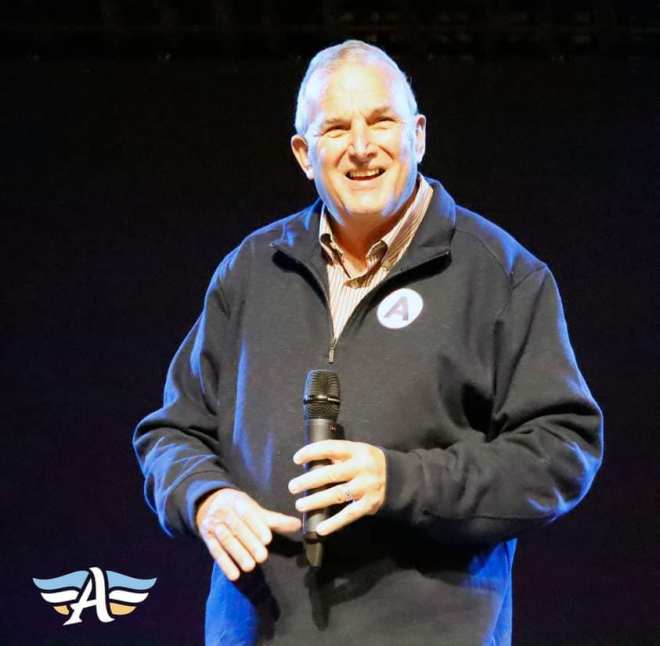
Turns out the person who made the announcement before about 150 people at a downtown Abilene events center was, wait for it, Scott Kirk, who is now President of the Abilene Flying Bison.
Scott’s wife, Nancy, posted a photo on Facebook of her husband making the announcement, so I called him to get the story of how it happened.
It begins with Scott connecting with George Lessmeister, a Kansas City resident who was scouting for a city to locate a team in a proposed developmental league, which would be unaffiliated with Major League Baseball.
“George Lessmeister’s involvement came through National Sports Services, which owns and operates several collegiate teams and also matches prospective owners with franchises,” Scott told me. “NSS and Ventura Sports Group are the co-founders of the Mid America League.”
It was a natural connection because of Scott’s long presence in the city of roughly 125,000 residents, and his past roles with previous teams.
AN ASIDE TO THE STORY: There’s an Oklahoma connection to all of this. Lessmeister previously considered locating the team in Edmond, where it would play on the UCO baseball field. But a deal could never be consummated.
So, now it’s the Abilene Flying Bison, instead.
 I asked Scott how the team was named. The Bison part is easy because of the city’s location in an area where the buffalo once roamed. The team added “Flying” as an homage to Dyess Air Force Base, Scott said. Dyess has a big local presence from its location on the west side of Abilene.
So, what about the league the Flying Bison will play in and where are the other teams located?
“We’re going to be playing in what is known as the Mid America League,” Scott told me. “It’s a developmental league with no Major League affiliation. The players are going to primarily be collegiate players. We can have guys who might have played pro ball for a couple years, and they can play for us. We just can’t pay them.”
Five cities have been identified for the six-team league, Scott said. In addition to Abilene, there are Sherman, Texarkana and White Oak, all in Texas, with the fifth team located in my home town of Fort Smith, Ark. Scott said the league is close to announcing the sixth location.
Here’s what I found out about the league on the Mid America League website:
“The League will play a 68-game schedule to start in late May and run through early August, concluding with playoffs to determine the League champion. The League will also be contracting with Opendorse to implement a program offering Name, Image and Likeness opportunities for players.”
Wait. NIL for an independent baseball league?
“I know it sounds like pay for play, but those are the rules we live by,” Scott said. “There are literally dozens of collegiate baseball leagues across the country. I would say there are probably 200 collegiate teams. One league, the Northwoods League, has almost 40 teams.”
I looked up the Northwoods League, which plays in the upper Midwest, and its website showed 25 teams in two divisions.
OK, Mr. President, what’s the next step for the Flying Bison and the Mid America League?
“Get a season completed,” Scott said. “If you complete your first season, your chances of success are better.”
So, Scott Kirk’s baseball story has come full circle. He DID have an unofficial affiliation with the Rio Grande WhiteWings. And now he’s leading a long-sought baseball revival in Abilene.
“The motivation for bringing a team to Abilene has always been about doing something that contributes to a sense of community in the city,” Scott said. “The overarching goal has been to build a venue that could serve as the home for a sports team in the future, whether it’s the MAL team or another team. If there’s a place for the team to play, it increases the likelihood of baseball or another sport to continue to play in Abilene.”
Maybe my memory from long ago wasn’t so faulty after all. Facts is facts.

 Jim Stafford's BlogOKC