Drivers beware, speed traps live on


What comes to mind when you see the words ‘speed trap?’ Barney Fife, perhaps?

Yeah, you know what they are. A cop car parked behind a sign or tree just off the highway, typically at the edge of a small town in an area where speed limit suddenly drops from say, 65 mph to 45.

Gotcha!

Way back in the olden days when I was in college driving from Abilene, Texas, back home to Fort Smith, Ark., I learned to be extra cautious when I drove through Stringtown, OK.

Stringtown was notorious for handing out speeding tickets to drivers passing through town on U.S. 69 and unaware that speed limit changed abruptly. It already had a reputation as a speed trap, and my dad warned me about it before I made my first trip.

By 2014, most everyone who didn’t hail from Stringtown had had enough. It was revealed that 76 percent of the town’s revenue — $483,000 in 2013 — was generated by traffic tickets, far more than the 50 percent cap set by the state legislature.

So, the Oklahoma Department of Public Safety announced that Stringtown police officers no longer could enforce traffic laws on state and federal highways.

Turns out that Stringtown was a repeat offender. It also drew state sanctions in the 1980s, three decades before the latest action. Read about it in this 2014 article from The Oklahoman.

But speed traps live on today in other communities across the state.

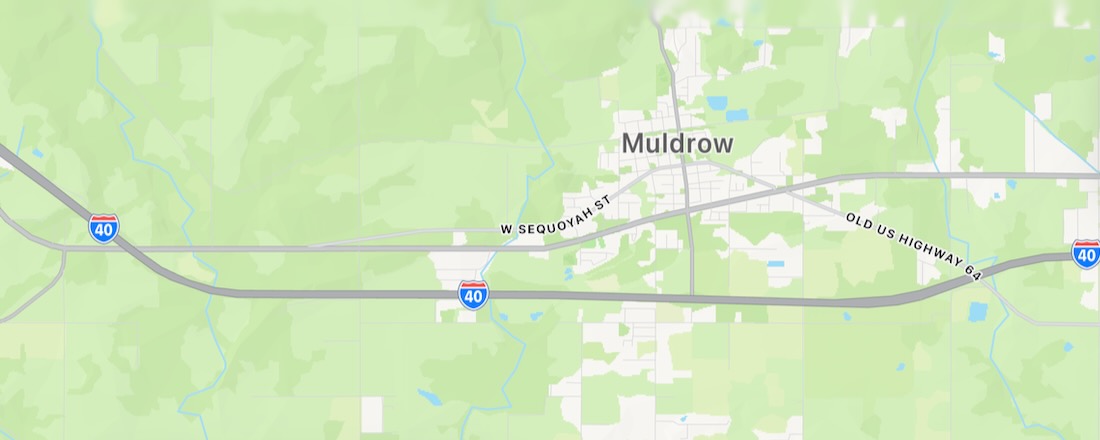
I drove through one in Muldrow, OK, just this past weekend. I saw a Muldrow police SUV hidden behind some barrels in the median of I-40 shortly before 7 am on Sunday.

Yes, Muldrow city officers were patrolling the Interstate! Maybe a quarter mile of I-40 goes through Muldrow city limits, which apparently gives their officers the right to patrol that stretch and hand out traffic tickets to protect their citizens.

I wasn’t even aware that stretch of I-40 was within the city limits of the city of Muldrow because it looks like a fairly rural area. Fortunately, I did not get pulled over — this time.

But the fact that he was out there monitoring traffic before sunup along the short stretch of Interstate that passed through the city limits really irked me.

So, I called the Muldrow Police Department on Monday to ask if they patrol the Interstate and why.

“Yes, because it is part of our city limits,” I was told.

OK, my next question was “does the city have an agreement with the state that allows it to patrol the Interstate in place of Highway Patrol?”

“I have no idea,” she said. “You will have to ask someone else that question.”

I’ve read that the state has to authorize communities to patrol state and federal highways that pass through their city limits, although I wasn’t sure that’s accurate. So I looked it up.

Here’s what I found in an online search of Oklahoma law:

“The Commissioner may designate any portion of the National System of Interstate and Defense Highways, and those portions of the federal-aid primary highways and the state highway system which are located within the boundaries of and on the outskirts of a municipality for special traffic-related enforcement by the Oklahoma Highway Patrol Division and issue a written notice to any other law enforcement agency affected thereby. Upon receipt of such notice, the affected law enforcement agency shall not regulate traffic nor enforce traffic-related statutes or ordinances upon such designated portion of the National System of Interstate and Defense Highways or such designated portions of the federal-aid primary highways and the state highway system without prior coordination and written approval of the Commissioner.”

I’ll translate:  The state highway commissioner can forbid municipalities from enforcing traffic laws on state and federal highways.

Muldrow’s next door neighbors in Roland also patrol their stretch of I-40, according to my friend and lifelong Roland resident Frank Day. In fact, I found this story about Roland’s well deserved speed trap reputation from a 1999 edition of The Oklahoman.

Reddit users provided many more known speed traps. “Asher, Big Cabin, Savanah, Calera… really any small town with a highway through it,” offered a user who goes by FakeMikeMorgan.

Anyway, small town speed traps always remind me of Deputy Barney Fife and his “Checkpoint Chickie” speed trap in Mayberry on The Andy Griffith Show back in the day. Watch a clip below.

I’m asking readers to submit their least favorite speed traps from around Oklahoma — and beyond. I’ll add them to this post and we can compile a list to help our fellow travelers in the future.

Consider it a service, like flashing your lights at ongoing vehicles after you pass a cop-in-waiting.

You’re welcome.

Here a speed trap contribution from Inona Harness via her son, Casey. Waukomis, OK, which is due south of Enid.  Thank you, Inona!
My college pal Scott Kirk brings baseball revival to Abilene

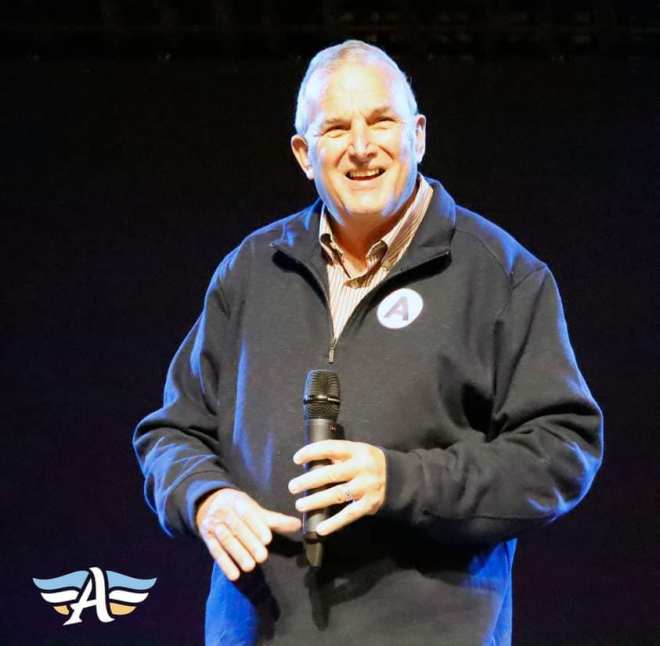
Scott Kirk Bison intro
Scott Kirk, president of the Abilene Flying Bison, introduces the new development league team on Dec. 14.

It’s funny how your memory can distort the facts over the years. When I first met Scott Kirk on the campus of Abilene Christian University in the fall of 1976, I was impressed because he had actually worked for a minor league baseball team in his hometown of Harlingen, Texas.

At least, that’s what I remembered from a distance of almost 50 years.

Scott recently corrected the historical record for me.

In reality, he actually worked as a sportswriter for the Valley Morning Star, covering the Rio Grande Valley WhiteWings baseball team that was based in Harlingen. He even took a year off from college to focus on the job as WhiteWings beat writer.

But I’m not letting the facts get in the way of my warm memory.

I remember Scott Kirk as a fellow student who was committed to sports journalism and loved the sport of baseball above all sports. He was and is one of my favorite writers both in college at the Optimist student newspaper and through a long career with the Abilene Reporter News after graduation. He closed out his career as a high school journalism teacher in Abilene.

By comparison, I was far behind Scott in my writing and reporting abilities when I landed on campus in 1976. But I loved baseball, and that sort of bonded us as members of the Optimist staff. We watched baseball on TV, talked baseball and drove to Arlington to watch the Texas Rangers play.

Scott and I have stayed in touch through the years, each of us playing a role in the other’s wedding, meeting in Dallas or Houston to watch baseball, and once playing a round of golf in 100+degree weather during a scorching Abilene summer.

Although he’s retired from roles as reporter and teacher, Scott continues to pursue his passion for baseball not only as a fan, but as someone working hard to bring a professional or semi-pro revival to Abilene. The west Texas city has been home to professional and independent baseball teams in both the distant and recent past.

pairie dogs logoblue sox logoBack in the 1940s and ’50s, it was home to a minor league team named the Abilene Blue Sox. There were two versions of the Abilene Prairie Dogs, one that played on the ACU campus from 1995-’99 and again for a one-year reprise in 2012.. Scott served as official scorer for the 1990s version of the Prairie Dogs.
Fast forward to Dec. 14, 2023. Scott’s vision for another Abilene baseball team became reality with the announcement that the Abilene Flying Bison developmental league team would begin play in May on the home field of McMurry University.

Turns out the person who made the announcement before about 150 people at a downtown Abilene events center was, wait for it, Scott Kirk, who is now President of the Abilene Flying Bison.

Scott’s wife, Nancy, posted a photo on Facebook of her husband making the announcement, so I called him to get the story of how it happened.

It begins with Scott connecting with George Lessmeister, a Kansas City resident who was scouting for a city to locate a team in a proposed developmental league, which would be unaffiliated with Major League Baseball.

“George Lessmeister’s involvement came through National Sports Services, which owns and operates several collegiate teams and also matches prospective owners with franchises,” Scott told me. “NSS and Ventura Sports Group are the co-founders of the Mid America League.”

It was a natural connection because of Scott’s long presence in the city of roughly 125,000 residents, and his past roles with previous teams.

AN ASIDE TO THE STORY: There’s an Oklahoma connection to all of this. Lessmeister previously considered locating the team in Edmond, where it would play on the UCO baseball field. But a deal could never be consummated.

So, now it’s the Abilene Flying Bison, instead.

Bison logoI asked Scott how the team was named. The Bison part is easy because of the city’s location in an area where the buffalo once roamed. The team added “Flying” as an homage to Dyess Air Force Base, Scott said. Dyess has a big local presence from its location on the west side of Abilene.


So, what about the league the Flying Bison will play in and where are the other teams located?

“We’re going to be playing in what is known as the Mid America League,” Scott told me. “It’s a developmental league with no Major League affiliation. The players are going to primarily be collegiate players. We can have guys who might have played pro ball for a couple years, and they can play for us. We just can’t pay them.”

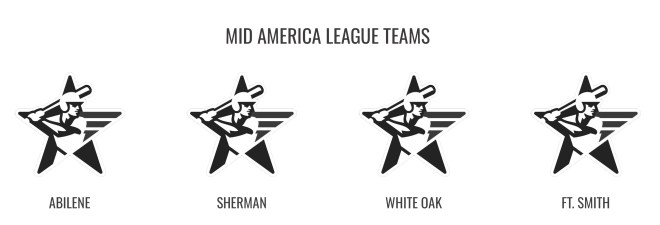
Five cities have been identified for the six-team league, Scott said. In addition to Abilene, there are Sherman, Texarkana and White Oak, all in Texas, with the fifth team located in my home town of Fort Smith, Ark. Scott said the league is close to announcing the sixth location.

mid america citiers

Here’s what I found out about the league on the Mid America League website:

“The League will play a 68-game schedule to start in late May and run through early August, concluding with playoffs to determine the League champion. The League will also be contracting with Opendorse to implement a program offering Name, Image and Likeness opportunities for players.”

Wait. NIL for an independent baseball league?

“I know it sounds like pay for play, but those are the rules we live by,” Scott said. “There are literally dozens of collegiate baseball leagues across the country. I would say there are probably 200 collegiate teams. One league, the Northwoods League, has almost 40 teams.”

I looked up the Northwoods League, which plays in the upper Midwest, and its website showed 25 teams in two divisions.

OK, Mr. President, what’s the next step for the Flying Bison and the Mid America League?

“Get a season completed,” Scott said. “If you complete your first season, your chances of success are better.”

So, Scott Kirk’s baseball story has come full circle. He DID have an unofficial affiliation with the Rio Grande WhiteWings. And now he’s leading a long-sought baseball revival in Abilene.

“The motivation for bringing a team to Abilene has always been about doing something that contributes to a sense of community in the city,” Scott said. “The overarching goal has been to build a venue that could serve as the home for a sports team in the future, whether it’s the MAL team or another team. If there’s a place for the team to play, it increases the likelihood of baseball or another sport to continue to play in Abilene.”

Maybe my memory from long ago wasn’t so faulty after all. Facts is facts.

mid america screen

Dr. Charlie Marler & the divine coincidence

marler office
Portrait of Dr. Charlie Marler in his office/ACU photo

I was sitting in a pew in the next-to-last row at Oklahoma City’s Quail Springs Church of Christ one Sunday in 1991 when someone tapped me on the shoulder.

I glanced back and almost fell out of the pew.

Sitting directly behind me was Dr. Charlie Marler, my favorite professor from my days as a student at Abilene Christian University. Dr. Marler taught most of the journalism courses I took at ACU and led the university’s journalism and mass communications program for many years.

Turns out, Dr. Marler was traveling through the state that Sunday morning and randomly decided to attend the Quail service. Quail was a large church, but somehow he ended up sitting directly behind me.

I took it as divine coincidence.

I had only been attending at Quail for about a year and had begun dating the woman who would become my wife, Paula Bottom. She was sitting next to me at that service, so I introduced her to Dr. Marler.

“Oh, you need to stay away from this guy,” he said with a smile.

I was at Quail because of the influence of Dr. Charlie Marler. Not only did he help guide me and motivate me to stay the course to graduation at ACU, he also modeled a life of faith for me that led me to Quail Springs church decades later.

I grew up in a church tradition different but similar to the Church of Christ, and had always been a religion skeptic. I’m not a smart man, but I always wondered why there were no professionals — no doctors or lawyers or college professors — in our little church growing up.

We had plenty of blue collar people who worked with their hands, and we were proud of it.

Anyway, Dr. Marler showed me that you could be highly educated and still have faith in a God of the universe. Years later, I recalled Dr. Marler’s faith when a friend invited me to Quail.

I attended the church reluctantly, but slowly came to accept the faith myself.

Along the way, I met Paula, we married and have been members of the Quail Springs church — now known as The Springs Church of Christ — ever since.

So, when Dr. Marler passed away late in May, it was a very personal loss to me even though I saw him only on rare occasions over the last 40 years or so.

I’m writing this to share how one life was influenced by his academic guidance, gentle patience and faith.

My college career at ACU also was a divine coincidence, I guess.

I wasn’t recruited to ACU in the 1970s. I wasn’t recruited by any college. Poor academic record. Poor study habits. Little involvement in my high school community.

But I had a dream. I wanted to go to college and study journalism. I wanted to be a sportswriter. I aspired to be Blackie Sherrod of the Dallas Morning News.

Somehow, life’s circumstances led me to Abilene, Texas, in the Spring of 1976. So, I sort of turned up on ACU’s doorstep with 30 hours at community college to my credit.

That twist of fate brought me into Dr. Marler’s sphere of influence for the next two-and-a-half years. I recall his teaching style with fondness because he seemed to involve everyone in each class but never singled anyone out for embarrassment.

He was notorious for marking up papers I wrote and articles I attempted for ACU’s student newspaper, The Optimist, with his red editing pen. Every ACU journalism student was subjected to the red editing pen .

Optimist3
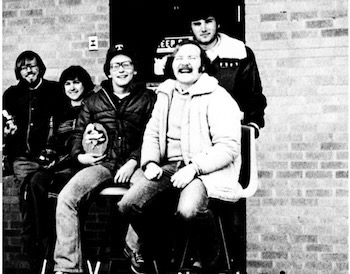
Me (front row, right) with colleagues from The Optimist in 1978

However, that red pen helped shape my writing style, and I slowly grew in confidence and ability.

And he talked about how Christians could — and should — work in newsrooms, keeping the faith while pursuing careers in a secular world.

It took years for the message to really sink in, but it finally hit home with the skeptic that I am.

Thanks to Dr. Marler, I had a 30-year newspaper career, and a decade-plus beyond that in the marketing office of a company.

Now, multiply the influence that Dr. Marler had on my life and career with thousands of other students over his 50-plus year academic career. That’s why he was a towering figure in journalism education and the Christian faith.

There is so much more to his story — read ACU’s wonderful tribute to him here — but this was the part of his life that touched mine.

The deal was finally sealed, you might say, when Dr. Marler tapped me on the shoulder at a random Sunday church service in Oklahoma City.

A divine coincidence.