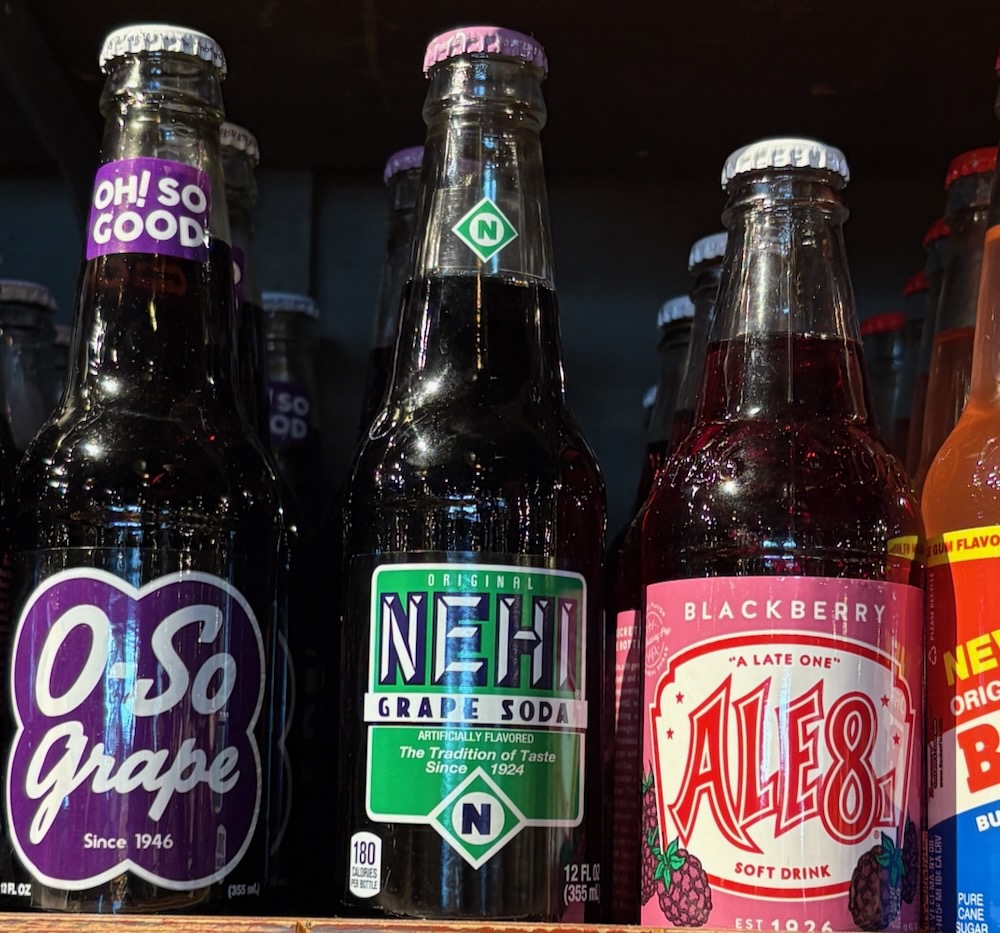
I discovered this bottle of grape Nehi during a recent visit to an OKC Cracker Barrel store.
If you are a fan of the long-running television comedy — dramady? — series, M*A*S*H, which aired from 1972-’83, then you are well aware that Radar O’Reilly’s favorite drink was Nehi grape soda.
Radar’s love of grape Nehi was a running theme across many seasons of the show. According to this History Oasis article, Nehi was mentioned in 47 episodes, with Radar once trading a month’s worth of coffee ration for a single case of his favorite soft drink.
I always perked up when grape Nehi was mentioned in a M*A*S*H episode, because it was the absolute favorite soft drink of my late grandmother, Vida Stafford. In fact, I’m pretty sure it was the only soft drink she would consume. There were always grape Nehi’s in her refrigerator.
As a kid, I helped myself to a grape Nehi whenever I visited my grandparents home in Booneville, Ark. I became a big fan of it myself.
Then over the years, I lost track of grape Nehi and assumed it was no longer being produced because I never saw the brand in stores. I haven’t even seen it at Pop’s in Arcadia, which is the mother-of-all-soda retailers, although maybe I just overlooked it.
So that brings me to August 2025. I discovered Cracker Barrel sells grape Nehi among the many nostalgic candy and soda brands it offers.
My wife and I were recently on a scouting mission to Cracker Barrel to gauge the pulse of its angry MAGA patrons during the brief period in which it changed its logo. (OK, we actually were there to enjoy some comfort food).
When we arrived at the store along I-35 in far north OKC, it was filled with customers, and we had about a 35-minute wait for a table. I didn’t hear any chatter about the logo or ‘going woke,’ but as I sauntered through the store during our wait, I stumbled upon a soda display that had a grape Nehi right in the middle.
It made my night. Grape Nehi lives!
A wave of nostalgia actually washed over me at the sight of the grape Nehi because of the memories made 60 years ago or more. I found myself right back in my grandmother’s kitchen rummaging through her refrigerator in search of a grape Nehi.
Did I load up on grape Nehi that night? I did not, but I do plan to try a bottle soon to see if it lives up to what I remember.
There are decades of wonderful memories wrapped up in that single bottle of grape Nehi. I hope it doesn’t let me down.
BONUS CONTENT: I ran across this article about a company in Cleveland, Miss., that has bottled Nehi sodas for almost 100 years. It was published in the Bolivar Bullet, a newspaper based in Cleveland.
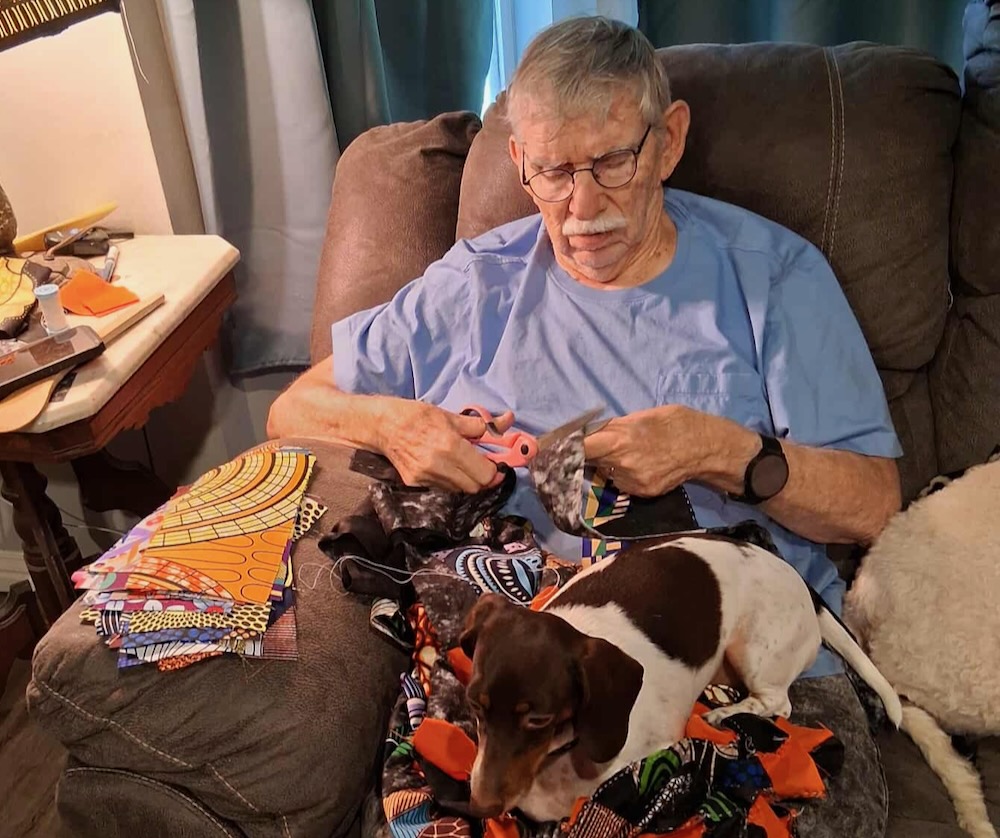
Frank Day works on a hand-stitched quilt, accompanied by one of his favorite pets.
Let me tell you about my friend Frank Day of Roland, OK, whom I have known since approximately 1971 when we both worked for Hunt’s Department Store in Fort Smith, Ark.
Over the years, we drank gallons of coffee together, ran trot lines at 2 am in the Arkansas River and stalked raccoons in the middle of the night in the Paw Paw Bottoms, among other adventures.
But life took me to Oklahoma City in 1983 for a job with The Daily Oklahoman newspaper, so we haven’t seen a lot of each other in the intervening years.
Today Frank is 75 years old and retired after more than two decades as fleet sales manager for Fort Smith’s Randall Ford. I think he can best be described in 2025 as a one-man quilting bee.
What?
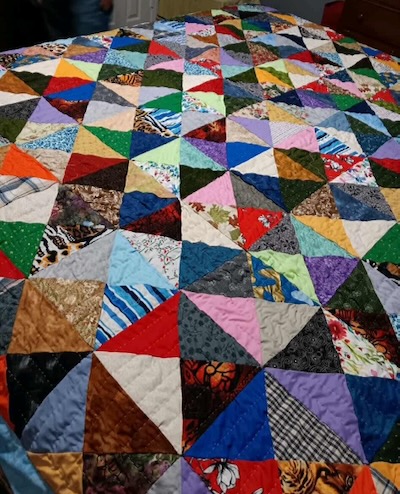
That’s right. Frank Day began hand-stitching beautiful quilts over two decades ago, and continues his quilting avocation today.
Frank, I thought I knew you.
There goes my image of the typical quilter as someone’s grandmother.
Turns out that quilting is something Frank learned as a child from his mother, Dortha Day and turned it into an ongoing hobby many decades later.
“When I grew up, Mother was quilting all the time,” Frank told me. “She belonged to a quilting club, a bunch of women who got together at someone’s house and could finish a quilt in one day. I grew up watching her, and she showed me how to do it.”
Frank’s wife of more than 50 years, Vicki, added her perspective.
“Frank’s mother Dortha always had a quilt rack on the ceiling,” Vicki said. “I remember Granny, everyone called her Granny, quilting on the old quilting frames and singing hymns. When the grandchildren came along they would all play under the quilt frame.”
However, Frank had never made a quilt until his first grandchild was born more than 20 years ago. He produced his first quilt for grandson, Trevor, and has continued quilting through the years.
“I said I’m going to get some material and make a quilt,” Frank said of that first attempt. “Vicki said ‘you don’t know how.’ I said, ‘you watch me.’ I got the material and sat down and started sewing. And I got it done.”
That first quilt led into one for each grandchild, then special quilts for relatives and friends. Sometimes he makes them for folks who’ve had a stretch of bad health or difficult life situation, like a former coworker at Randall Ford to whom he presented a quilt.
“She started crying, but it was because she was happy to get it,” Frank said.
A quilt is not made in a day. Or a week. It might require more than a month of work for a solo quilter like Frank Day.
“From start to finish, if it’s a king-sized quilt, you have about 250 hours in it,” he said. “That’s cutting the material out — I hand sew everything, nothing is made on a machine. I hand stitch it, get the backing for it, get the lining for it and put the blocks on top.”
Did you catch that … 250 hours for a single quilt. That’s 6-1/4 40-hour working weeks of quietly sitting alone stitching blocks of material together into what can be a beautiful pattern.
My own grandmother was a quilter, and I recall she had a large wooden frame that she let down from the ceiling that helped her make her quilts.
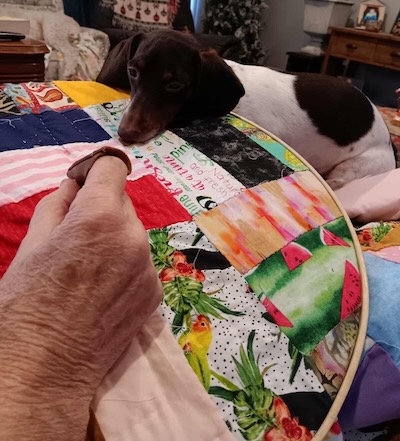
Frank uses a ‘hoop’ that he holds in his lap as he quilts. Usually, one of his favorite dogs is sitting nearby or even on his lap as he quietly works.
Although he hasn’t made quilts to sell, Frank told me that comparable hand-made quilts can be priced at $1,800-$2,500 because of all the time required to produce one.
“It’s very time consuming, and most people don’t have the patience for it,” he said.
I learned that Frank was a quilter after Vicki posted some pictures of beautiful quilts on Facebook and I complimented her on her quilting talent. She corrected me and said it was all Frank.
“When Frank made his first quilt before Trevor, our first grandchild, was born, we had been married for 30 years and he never made one before,” Vicki said. “I asked him why he never made one before and his answer was “I never had a reason to make one.”
“Frank’s quilting has bloomed over the years. He made one for our son, Paul, as a wedding gift and then for our daughter Jenny. He made one out of cancer warrior scarves that Ford gave to dealerships for Breast Cancer Awareness.”
Each quilt is made with a purpose.
“Frank had a good friend, Dudley Sparkman, who was the best man and friend you could ask for,” Vicki said. “Sadly, he had a massive heart attack on his 50th birthday and passed around two weeks later. Tina Sparkman, Dudley’s wife, asked Frank if he would make a lap quilt out of some of his shirts. That was probably one of the hardest quilts he ever made because on the friendship they shared.”
Quilters like Frank Day who make the time to sit and hand-stitch a beautiful design are a rarity in 2025. Today, most quilts are machine stitched.
Frank calls hand-made quilting a “dying art” that he’s keeping alive in his corner of the world. Currently, he’s working on a quilt for Vicki as he recovers from a recent knee-replacement surgery.
“It’s helped me keep my sanity when I’ve had to sit for long stretches as I recovered from knee surgery that put me down,” he said. “I’ve finished one and got close to half of another one put together.”
It’s one stitch after another after another for a quilter like Frank Day. That translates into hundreds of hours to produce just one quilt.
It’s a marathon, not a sprint.
Frank has run that marathon for more than two decades.
And that’s why I describe him as the ultimate one-man quilting bee.
BONUS CONTENT:
I asked ChatGPT to explain the concept of a “Quilting Bee” to me. Here’s what it told me:
A quilting bee is a social gathering where a group of people—traditionally women—come together to work on quilting projects, usually a large quilt, while also enjoying conversation and community.
Key Features:
– Collaboration: Multiple people contribute to making one quilt. Often, the quilt top is pieced together ahead of time, and the bee focuses on quilting (stitching the layers together). – Social aspect: It’s as much about socializing and bonding as it is about the sewing. These gatherings were historically important social events, especially in rural communities. – Tradition: Quilting bees have roots in 18th and 19th century America, when they served as a practical and communal way to create bedding before mass production. – Modern bees: Today, quilting bees still exist, though they might be less formal or might happen in quilting guilds, workshops, or even online.
Think of a quilting bee as a mix of a sewing circle, a social event, and a creative collaboration.
Cover of the Oklahoma Scoundrels book that described law enforcement dispute from the 1800s.
The introduction to “Oklahoma Scoundrels: History’s Most Notorious Outlaws, Bandits & Gangsters” about the state’s wild territorial days gave me a feeling of déjà vu all over again, as Yogi Berra used to say.
The book, authored by Robert Barr Smith and Laurence J. Yadon and published in 2016, describes the challenge facing Oklahoma Territory law enforcement in the late 1800s. Native American tribes relied on their own police known as the Lighthorse to keep order. The United States relied on U.S. Marshals and their deputies.
This is where the tale gets interesting, because it could have been written about eastern Oklahoma in the wild west of law enforcement in the 2020s.
Here’s a quote from the book about 1800s Oklahoma Territory law enforcement:
“Save for occasional abuses, the system worked well. Except for one problem. Tribal jurisdiction was very limited. A tribe’s Lighthorse law officer — say the Creek police — could arrest only members of his own tribe and men of other tribes who committed crimes within the Creek nation.
“The jurisdiction of the United States was similarly complex: a deputy marshal could only arrest United States citizens. A marshal could arrest an Indian only if a crime was committed against a U.S. citizen or involved alcohol (bootlegging being the perennial curse of the territory).”
Sounds familiar, doesn’t it?
The Supreme Court’s landmark McGirt decision in 2020, which recognized the sovereignty of the Muscogee (Creek) tribe and eventually expanded to the rest of the Five Civilized Tribes, created confusion among entities that provide law enforcement throughout eastern Oklahoma.
In the wake of the McGirt decision, state of Oklahoma law enforcement agencies lost authority to prosecute many crimes involving Native Americans — either as victims or perpetrators — on reservation land. Instead, federal or tribal authorities now have jurisdiction in many cases.
Major crimes such as murder or rape involving Native Americans fall under federal jurisdiction via the Major Crimes Act. Tribal courts handle misdemeanors and other offenses.
While the five tribes — Cherokee, Choctaw, Chickasaw and Seminole, in addition to Muscogee (Creek) — celebrated the decision as affirming their sovereignty, Oklahoma Gov. Kevin Stitt has been vocal in his criticism. He has been relentless in efforts to have the ruling overturned, claiming it has caused a public safety crisis in eastern Oklahoma, with criminal cases dismissed and prisoners released, as well as a threat to the state’s authority.
The tribes scoff at Stitt’s claims and say their law enforcement and courts are capable, plus they have signed enforcement agreements with multiple cities and counties across their territories in eastern Oklahoma.
A 2023 Tulsa World article focused on the ‘cross-deputization agreements,’ which allow local law enforcement agencies to jointly enforce tribal, state and federal laws.
“All Tulsa Police officers are cross-deputized with the Muscogee Nation Lighthorse and Cherokee Marshals,” the World article said. “As of 2022, the Muscogee (Creek) Nation had 63 cross-deputization agreements with entities within its sovereign boundaries.”
Back to the Oklahoma Scoundrels tale.
The book says the U.S. and tribal systems of law enforcement sometimes clashed over jurisdiction in the Oklahoma Territory. It describes a deadly shootout between U.S. Marshals and tribal court officials in eastern Oklahoma.
“The worst conflict came in 1872 near the Arkansas border at Going Snake Schoolhouse, then being used as a temporary tribal courthouse. U.S. officers tried to arrest the defendant, the court objected and the resulting shootout with court personnel, spectators and even the defendant left at least 10 men dead and the defendant on the run.”
Whoa! Ten men died over a law enforcement dispute.
Turns out, we’ve sort of replayed that confrontation in a real-world 2025 dispute. Only not as deadly.
In January of this year, a Muscogee Nation Lighthorse Police deputy chief got into a scuffle with a jailer at the Okmulgee County Jail, despite cross enforcement agreements in place.
“Body-worn camera footage from the Lighthorse officer shows jail official Matthew J. Douglas refusing the detainee, claiming that it was against the jail’s policy to accept prisoners from Lighthorse police. Some jail staff can be heard on the video saying Lighthorse officers are not ‘real police.’
“A physical altercation between Douglas and Lighthorse Deputy Chief Dennis Northcross began behind a closed door, video shows. As other Lighthorse officers tried to enter the room, a brief shoving match ensued at the door.”
Whew! At least in the 2025 version, no guns were drawn or officers from either side gunned down.
You know that old saying about history repeating itself. Well, it happens.
And that’s why I have déjà vu, all over again.
SPONSORED CONTENT: I came across Oklahoma Scoundrels while researching books on Oklahoma Outlaws for my mother in-law. Once I got into the book, from the first chapter on Belle Starr, I couldn’t put it down. It is captivating content on well known and not-so-well known Oklahoma Territory criminals from the 1800s. Buy it at Amazon and read for yourself. https://amzn.to/4medMMW
 That’s right. Frank Day began hand-stitching beautiful quilts over two decades ago, and continues his quilting avocation today.
 Frank uses a ‘hoop’ that he holds in his lap as he quilts. Usually, one of his favorite dogs is sitting nearby or even on his lap as he quietly works.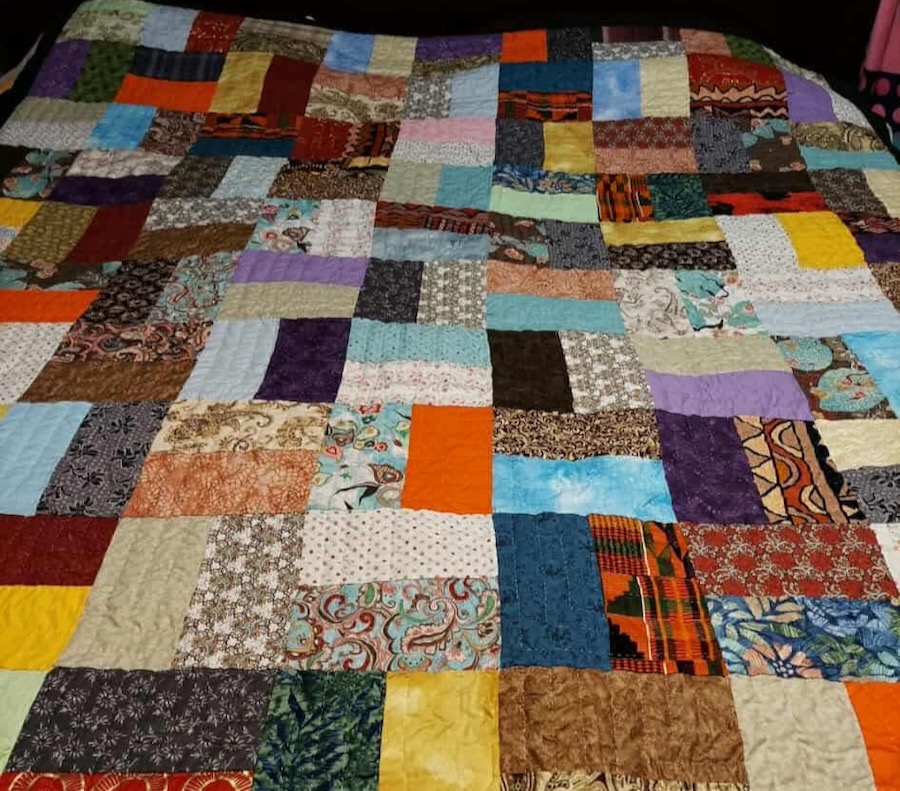
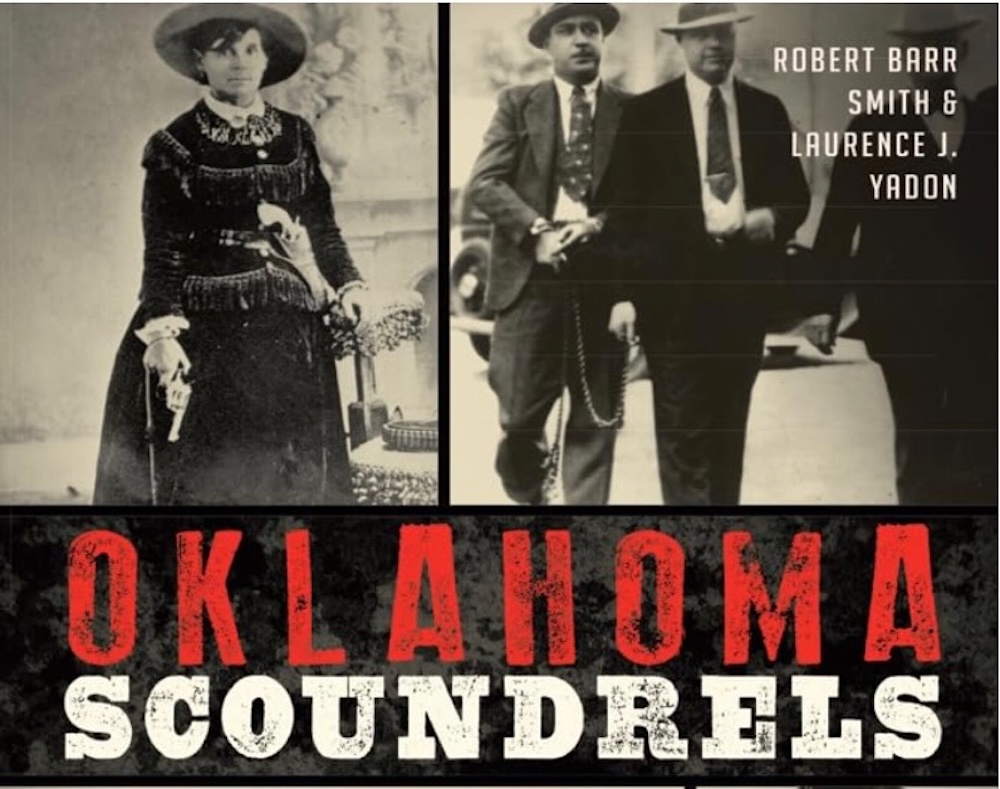
 SPONSORED CONTENT: I came across Oklahoma Scoundrels while researching books on Oklahoma Outlaws for my mother in-law. Once I got into the book, from the first chapter on Belle Starr, I couldn’t put it down. It is captivating content on well known and not-so-well known Oklahoma Territory criminals from the 1800s. Buy it at Amazon and read for yourself.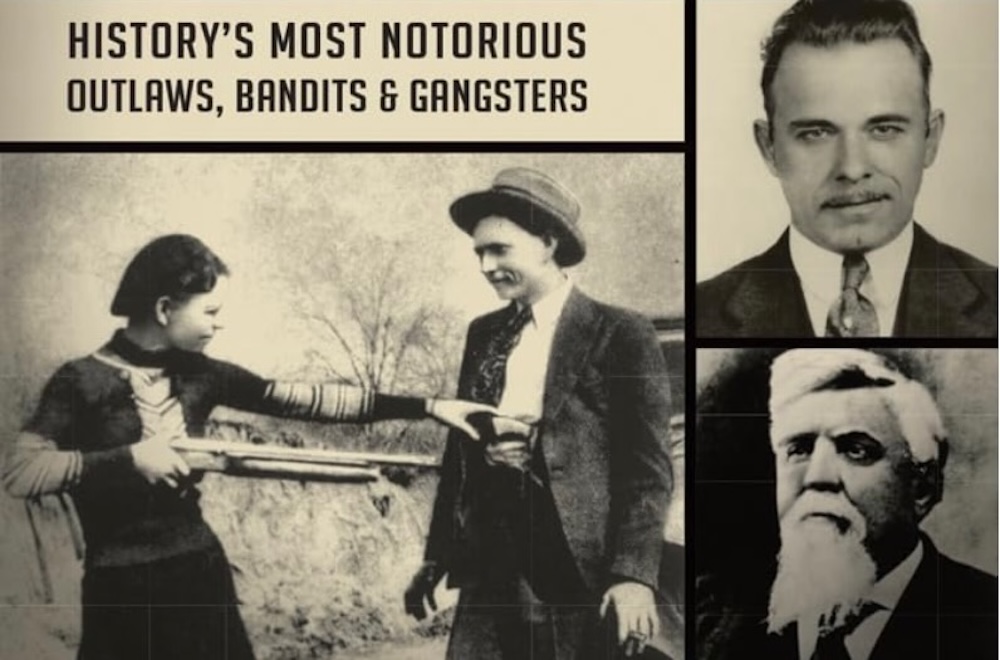
 Jim Stafford's BlogOKC