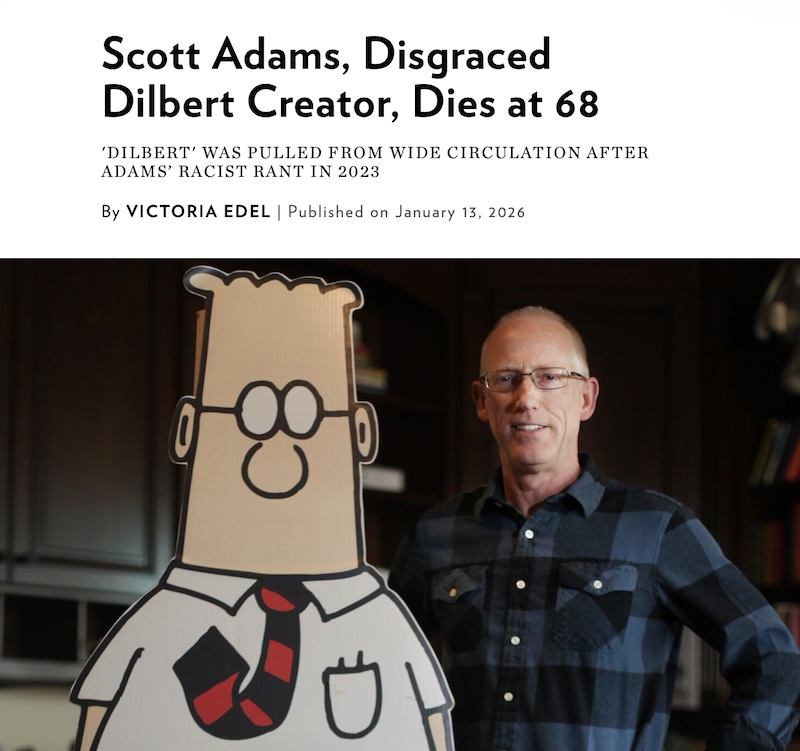
Editor’s Note: Scott Adams died this week from the effects of cancer. I wrote the column below back in 2023 after he made several racist statements, and will leave it up on this blog. However, I think it’s important to acknowledge his death and that his legacy will be the way his career as a cartoonist ended rather than the brilliance of his Dilbert strip.
I went back through my social media history this morning and came across a dozen or more Dilbert comic strips I have posted over the years.
If you aren’t familiar with Dilbert, it’s an insightful, often hilarious syndicated comic strip that skewers corporate office life. It features Dilbert, an engineer, his co-worker Wally and the pointy-haired boss, among others.
Wally was my personal favorite because of his ability to goldbrick every day and get away with it while still drawing his salary. Oh, and he always has a coffee cup in his hand.
So, it hit me hard when a text over the weekend from a former co-worker at The Oklahoman delivered some devastating news.
Dilbert author Scott Adams revealed himself to be a racist with some horrific comments on his streaming video program, “Real Coffee with Scott Adams.” Here’s an article from the San Jose Mercury News reporting Adams’ comments.
On the program, Adams cited the results of a poll of Black Americans on racial views, then calling Blacks a “hate group,” and recommending that white Americans segregate themselves.
“Based on the current way things are going, the best advice I would give to white people is to get the hell away from Black people,” Adams said.
He also bragged about spoofing the current sexual/racial identity discussion by claiming to “identify as Black” until now.
I hesitate to publicly call out anyone as a racist, but when someone like Scott Adams uses his platform to disparage an entire race of people, there’s not much doubt about his personal character.
However, Adams isn’t a first-time offender. I’ve been troubled the past few months about other things Adams has posted, like constantly backing right-wing conspiracy theories.
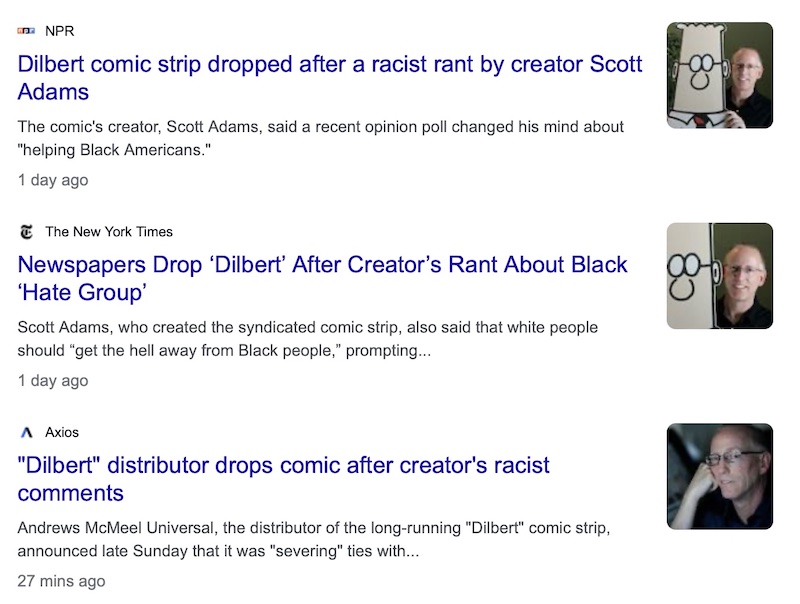
If you search “Scott Adams” online today, you will find headline after headline about newspapers that are cancelling Dilbert.
Although, Adams attempted to defend himself in a more recent video presentation, he also said that “most of my income will be gone by next week” and that “my reputation for the rest of my life is destroyed.”
You brought this on yourself, Scott Adams. You had to know that racist comments like this would bring down your syndicated comic empire.
Obviously, Adams wanted to get out of the business of creating a daily comic strip. Maybe he will reinvent himself as a leader of a fine organization like the Oath Keepers.
But this isn’t 1950s America where white folks felt empowered to wear their racism on their sleeves. Our society today demands empathy and understanding for everyone.
I’m going to miss Dilbert and Wally. But it had to happen.
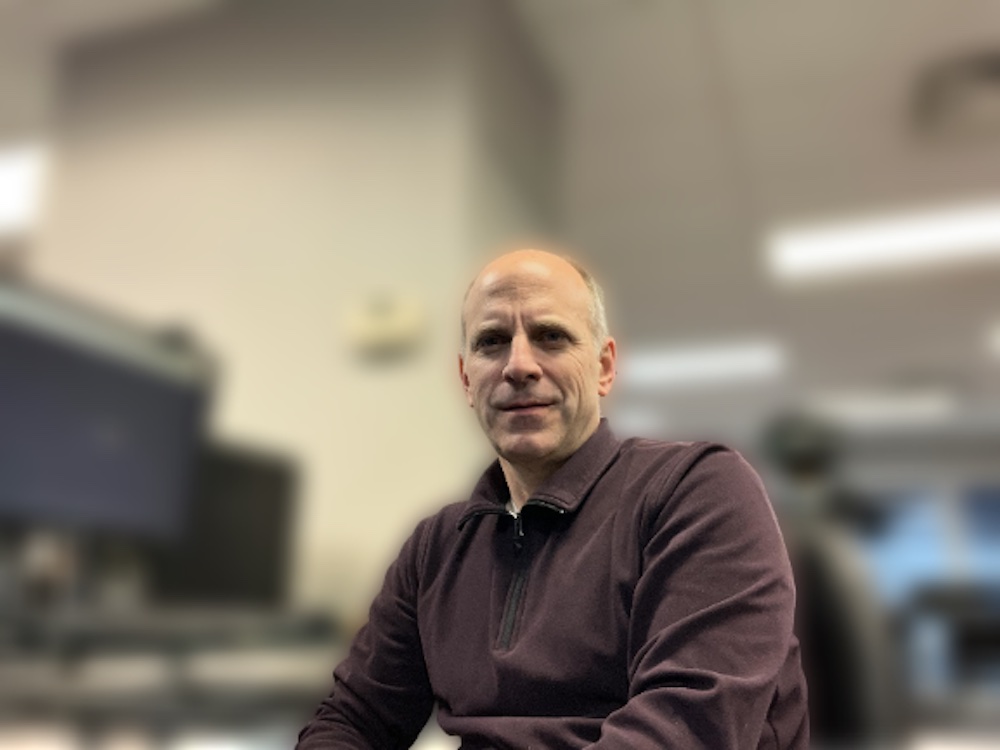
Oklahoma-based software engineer John Hassell has embraced artificial intelligence chatbots as part of his daily workflow.
In the past couple of months, I’ve heard more about artificial intelligence (AI) chatbots than any other topic, except, perhaps, the media hysteria caused by Chinese spy balloons.
According to IBM, a chatbot is a computer program that uses artificial intelligence and natural language processing (NLP) to understand questions and automate responses to them, simulating human conversation.
The essays turned out well written and with solid arguments.
Meanwhile, we’ve seen a lot of hand-wringing from ethicists over the potential of AI bots to write term papers for high school and college students or mimic the voice of well known people to have them say outrageous things.
So, the jury’s still out on what our future will look like with AI Chatbots churning out reports, papers and art. But there are people who already embrace the potential of chatbots as tools to enhance their workflow.
One of those is Oklahoman John Hassell, who works as an embedded software engineer for Tactical Electronics in Broken Arrow. I’ve known John since 2005, when he was a Ph.D. candidate at the University of Oklahoma and entered the Donald W. Reynold’s Governor’s Cup collegiate business plan competition with a concept known as ZigBeef.
As pitched by John and his team in the Governor’s Cup, Zigbeef applied RFID technology to ear tags for cattle as a way to easily identify them and ensure a safe beef supply for consumers.
ZigBeef won second place in the Graduate Division of the Governor’s Cup.
After completing his Ph.D. and pursuing ZigBeef for a number of years, John has gone on to work in embedded software development, as well as applying his skills to mobile app development.
So, I was pleased to hear from him recently when he described how ChatGPT has quickly become a major factor in his workflow.
John said he heard about AI and initially was skeptical of any potential benefits.
But an OpenAI art program known as Dall-E changed his perspective. He asked it to draw a photo from his memory of his family’s old two-story farm house near Okemah.
“On a lark, the first time I used it, I typed in a paragraph describing a mental picture of the sandy road, surrounded by a pecan tree orchard, leading up to the white farm two-story house,” he said. “OpenAI’s system produced something shockingly similar to what I was imagining. The picture it created in seconds was suitable for hanging in my office as a picture.”
Now you know why the art world has been in an uproar over AI potential.
Next, Hassell asked ChatGPT to produce some programming code that involved an obscure Linux script.
“In a second, ChatGPT comprehended exactly what I needed to do, and then provided the working code to do it,” he said. “I had been working on that issue for weeks.”
“Once again, ChatGPT provided an easily readable, accurate summary, correctly punctuated, with an interesting fact, for each legislator and their district,” John said. “It was not completely accurate and had to be checked. Nevertheless, it saved an incredible amount of tedium and time in writing this program.”
I wanted to know more about the perspective John has gained about AI and the Chabot, so I asked him a few more questions. Here they are in Q&A format:
Q: How has AI helped streamline or enhance what you do?
A: I’ve actually started to migrate away from my standard resource of programming help, sites like StackOverflow and Google search. Now, I am able to ask specific questions that tend to get me answers quicker.
Q: Isn’t using an AI Chatbot considered cheating?
A: It is somehow cheating the same way that leveraging a calculator was somehow cheating in the 1970s, or that using a tractor instead of a mule team was cheating at the start of the last century. New technology is neither ethical or unethical, it just is. We will find if we aren’t using this technology in future years we are just left behind.”
Q: How much do you worry about inaccurate feedback you receive from Chatbot?
A: In my few short weeks of usage, it has indeed been inaccurate many times. However, the inaccurate solutions provided, or the prose presented, still brought me much farther and quick ahead than without it.
Q: There seems to be some fear about how AI will impact our future in a negative way; what is your perspective on that potential?
A: I can tell you that after using ChatGPT the past few weeks, the user interfaces on my smart phone, on my truck radio, even on most websites, seem antiquated. Having to search for, and manipulate computer controls, in such a precise and particular manner feels so “old” already. Not to be too dramatic, but this will change will be huge… and it’s happening with record speed.
Q: What else would you like us to know about the topic of AI Chatbots or your work?
A: Interestingly, I’ve gotten better at using ChatGPT in my programming work by thinking less like a computer programmer in many ways. Now, instead of overly-specifying what I need, and the way I need it, I revert to more-human prose, asking what I ultimately need… not trying to tell ChatGPT on how to find the answer for me. I’m having to de-program my decades of learning and specifying the minutiae of how to get things done with a computer. Now, ChatGPT has learned to do a lot of that. I look forward to seeing these improvements in all the tedious things we all have to deal with in interacting with all the machines that are here to help us.
Takeaway: I only heard about ChatGPT a few months ago, and thought that its impact wouldn’t show up for years while it was being perfected.
But as John Hassell has demonstrated, Chatbot’s future is now. We should embrace it.
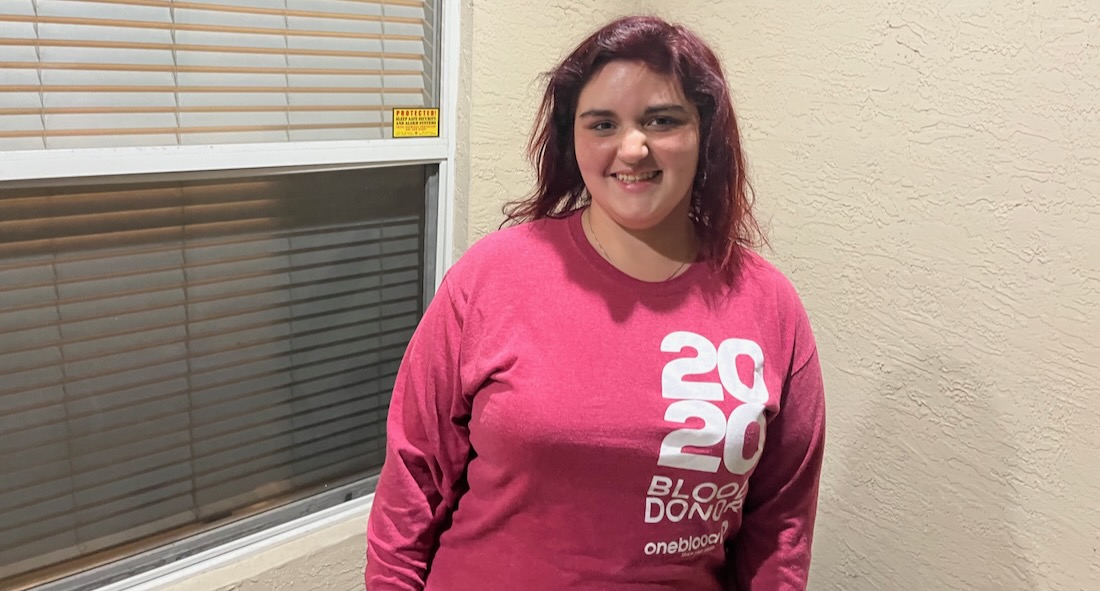
Sarah Stafford poses in her South Florida residence
EDITOR’S NOTE: For the past year and a half, my 24-year-old daughter, Sarah, has worked as a “tech” at drug-and-alcohol rehabilitation centers in South Florida. She is trained in CPR because of the potential for relapse and overdose of recovering addicts. Sarah is a recovering addict herself, and lives in a nearby home occupied by other recovering addicts with house rules that support their road to recovery. It’s not always easy, though. Temptation sometimes leads addicts to relapse with potential deadly consequences. This is Sarah’s story about a recent incident in her home.
By Sarah Stafford
Around 1:40 pm on Wednesday, January 11th, my housemate came home and went into her bedroom. About two minutes later she comes out and says, ‘Sarah can you come check on my roommate, I think she’s asleep but I also think I heard the death rattle, so can you wake her up and make sure she’s OK?’
I said ‘of course,’ and got up and went in there. The light was off cause we thought she was initially asleep. I shake her leg and say her name and she doesn’t respond. I shake her leg a little harder and say her name a lil louder, and she still wouldn’t respond. I get up and turn on the light and she’s pale but also blue around her eyes and lips. I notice a trickle of blood that’s come out of the corner of her mouth. I tell her roommate to call 911 and run into the living room and grab a thing of NARCAN. I wait a minute or two and am saying her name and lightly slapping her in the face to wake up. My housemate gets off the phone and is attempting to call our other housemate , whom the girl that OD’d is really good friends with. As I grab and administer another dose of NARCAN. the fire department calls us back asking if she has a pulse.
I check both her carotid and radial pulses, which were there but very faint. The fire department tells us we need to begin giving compressions. I look at my housemate, and she says she doesn’t know how, so I begin giving compressions consistently for about three minutes, and I’m getting exhausted.
The fire department tells me to do five. break two. which I begin doing, and as I start doing that my housemate I’m working on is starting to show signs of coming back. She’s gasping a bit and her eyes are starting to roll back. As the paramedics rush in 8-9 deep, I’m still working on her and she sits up gasping and choking but still isn’t really there. Three or four paramedics help her stand up and assist her outside to the gurney, where they give her a third dose of NARCAN in an IV. She goes to the ER and gets discharged that same evening. I was able to see her more alive and as OK as she can be after something like that as I help her pack her things and she returned to detox that night.
My comments: As scary of a situation it was, I’m grateful we had the best possible outcome for such a thing, and I’m grateful my housemate said something when she did or it could’ve been a completely different outcome. NARCAN saves lives, and I truly got to see that. While I hope to not have to do anything like that again I’m grateful I’ll know exactly what I need to do.
Editor’s note: Sarah, I’m so proud of you for jumping in and putting your life-saving skills to work and saving this young woman’s life. You are making a difference. Stay on this difficult road to recovery and continue to make a difference for the people you live with and serve.

 Jim Stafford's BlogOKC